Coffee Mug and Donut Cute Vector Art
First Impressions: Sweet, Simple, and Stitch-Ready
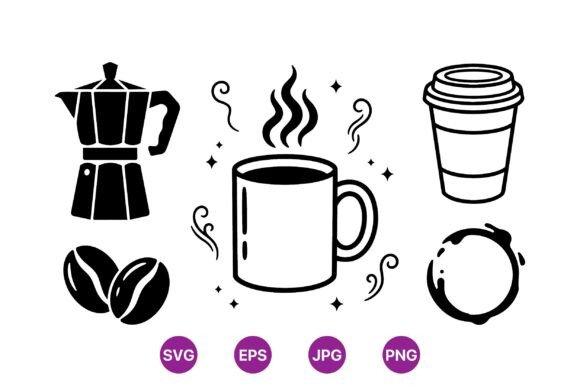
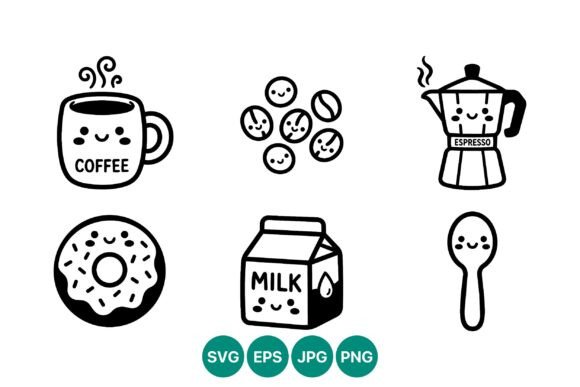
Opening the ZIP for Coffee Mug and Donut Cute Vector Art, I immediately felt that familiar spark—the kind you get when a design just *gets* the vibe you’re after. It’s not overly detailed or fussy; it’s a clean, black-and-white cartoon set with personality: a mug labeled “coffee,” a grinning espresso maker, a milk carton with rosy cheeks, a glazed donut, scattered beans, and a spoon wearing sunglasses. The lines are confident but friendly, the proportions balanced for small-scale visibility, and the spacing between elements feels intentional—not cramped, not sparse. As an embroidery designer who’s stitched hundreds of food-themed motifs, I knew right away this wasn’t just clipart. It’s built for translation into thread.
A Real Project Test: Embroidering a Kitchen Towel Set for a Local Café
Last week, I used Coffee Mug and Donut Cute Vector Art to create a trio of embroidered kitchen towels for a neighborhood café launching its weekend brunch menu. We chose lightweight cotton terry—soft, absorbent, but with enough texture to hold detail without flattening stitches. I placed the mug + donut combo (centered, scaled to 3.2” wide) on the lower corner of each towel. No applique design needed—the vector outlines translated cleanly into satin stitch borders and light fill stitch interiors. Customers loved the warmth and whimsy. One even asked if we’d embroider the same motif onto aprons—and yes, it worked beautifully there too, especially on midweight twill with tear-away stabilizer.
Where This Design Shines in Real Embroidery
- Custom apparel: Works especially well on crewneck sweatshirts and relaxed-fit tees—its rounded shapes soften harsh fabric tension and read clearly at arm’s length.
- Tote bag design: The bold outlines hold up against canvas weave; no detail gets lost in the grain.
- Baby embroidery: Gentle curves and minimal fine lines make it ideal for onesies and burp cloths—no risk of scratchy dense stitching near delicate skin.
- Embroidered patch: Clean separation between elements means easy cut-and-sew application, even for beginners.
- Holiday embroidery: Paired with red or cream thread, it reads instantly as cozy winter gifting—think mugs on tea towels for teacher appreciation or donuts on oven mitts for bake-sale volunteers.
- Etsy seller & small shop product: Feels handmade without looking amateurish—a big trust-builder for buyers scanning listings quickly.
Where to Use It Thoughtfully
This isn’t a one-size-fits-all embroidery file. Its charm lies in clarity, not complexity—so keep these practical realities in mind:
- Small hoop sizes: Avoid cramming all six elements into a 3” hoop. Pick two or three core pieces (e.g., mug + donut + bean) for tight spaces like cap fronts or baby caps.
- Textured or stretchy fabric: On knits or fleece, use cutaway stabilizer and reduce stitch density slightly—those smiling faces can blur if fill stitches crowd too tightly.
- Dark fabric: Since the original is black-and-white vector art, test thread colors carefully. A warm tan or creamy off-white pops better than stark white on charcoal twill.
- Curved surfaces: Caps and hats need gentle digitizing adjustments—especially around the espresso maker’s steam swirl. Don’t skip a test sew on a curved mockup.
- Tiny lettering: That “coffee” label on the mug? It’s legible at 0.25” height on stable fabric—but won’t resolve cleanly below 0.18”. If your project demands micro-detail, simplify or omit the text.
What It Adds to Your Finished Product—Beyond Just Looks
Using Coffee Mug and Donut Cute Vector Art does more than decorate—it elevates perception. On a handmade product, it signals intentionality: someone chose this because it fits the story, not just fills space. For Etsy sellers, that translates to higher perceived value and better conversion. Buyers recognize friendliness and approachability in those smiling faces—they imagine giving it as a personalized gift, not just buying decor. And for craft business owners building brand consistency, it slots neatly into a broader “cozy kitchen” visual language—pair it with handwritten fonts, warm neutrals, and natural fiber photography for cohesive printable mockups and digital product previews.
Practical Embroidery Designer Notes
- Always test the embroidery file on scrap fabric first—especially if using textured cotton, linen, or blends.
- Check thread color contrast early: what reads as cheerful on-screen may vanish on dark denim or heather grey.
- Review stitch density before finalizing—some vector-to-embroidery conversions overfill small shapes. Lighten fill stitch density by 15–20% if needed.
- Confirm your intended hoop size matches the design’s natural scale. When in doubt, go slightly larger rather than smaller.
- Inspect corners and inner curves—those smiling espresso maker eyes and donut sprinkles need clean satin stitch termination.
- Test in black-and-white mockups to assess silhouette strength—this design relies on shape recognition, not shading.
- Compare performance on light vs. dark backgrounds. Some elements (like the spoon’s sunglasses) gain or lose impact depending on contrast.
- Use appropriate stabilizer: tear-away for stable wovens, cutaway for knits or loosely woven tea towels.
- Verify licensing terms before selling finished items or bundling the digital embroidery file into kits—commercial use rights aren’t implied by download alone.
Final Thought: A Reliable, Joyful Workhorse
Coffee Mug and Donut Cute Vector Art isn’t flashy—but it’s dependable, expressive, and quietly versatile. It doesn’t shout. It smiles. And in embroidery, where every stitch carries weight and wear, that quiet confidence makes all the difference. Whether you’re stitching a single personalized gift or scaling up for a boutique’s holiday collection, this set delivers consistent charm without demanding perfection from your machine—or your patience. It belongs in the toolkit of any designer who values clarity, warmth, and real-world usability over trend-chasing noise. And honestly? That mug still makes me smile every time I see it stitched on a towel, a tote, or a tiny onesie sleeve.