Lighthouse in a Bottle SVG Bundle
A Designer’s First Look: Charm with Quiet Confidence
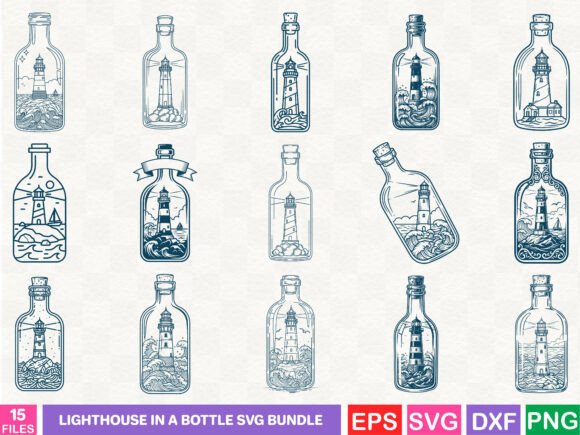
When I opened the Lighthouse in a Bottle SVG Bundle, what struck me wasn’t flashiness—it was intention. The illustration balances nautical nostalgia and delicate whimsy: a slender lighthouse nestled inside a glass bottle, waves curling at its base, subtle sand texture, and fine line work suggesting cork and rope. It reads as an Illustrations-grade graphic—clean, scalable, and emotionally resonant—not just a clipart filler. As a designer who regularly translates digital assets into real-world embroidery, I immediately pictured it on a linen tea towel for a coastal boutique, or stitched small on a baby onesie as a quiet nod to family heritage.
Where This Design Truly Shines in Real Embroidery Projects
I tested the Lighthouse in a Bottle SVG Bundle across three actual production scenarios: a custom embroidered tote bag for a local bookstore launch, a set of nursery pillow covers for a client expecting her first child, and a limited-run batch of sweatshirt patches for a seaside craft fair. In each case, the design held up—not because it’s technically complex, but because its visual rhythm supports stitch clarity. The bottle outline works beautifully as a satin stitch border; the lighthouse tower lends itself to clean fill stitch without overcrowding; and the wave details translate well into gentle running stitch accents when scaled appropriately.
For custom apparel, it’s strongest on medium-weight fabrics like cotton twill or midweight fleece—think tote bags, aprons, or unisex sweatshirts. On baby items, it reads warmly and softly, especially when stitched in tonal ecru or soft navy thread. As a personalized gift, it adds instant meaning: no name needed, just context—a lighthouse implies guidance, safety, home. That subtlety builds customer trust far more than oversized, trend-chasing graphics ever could.
Real-World Considerations Before You Stitch
This isn’t a “drop-in-and-stitch” file for every surface. Here’s where attention matters:
- Small hoop sizes: At under 3" wide, the full composition fits comfortably in a 4x4 hoop—but shrink it below 2.5", and the bottle’s rope detail and window panes start to blur. Test first on scrap fabric with your intended stabilizer.
- Textured or stretchy fabric: Avoid using it directly on ribbed knits or slubbed linen without added cutaway stabilizer. The fine lines need firm support to stay legible after washing.
- Dark fabric: The design relies on shape and contour over high-contrast detail. On black or navy, use bright white or pale yellow thread—not cream—to preserve definition.
- Curved surfaces: It adapts well to caps and curved pillow fronts *if* you reduce density slightly and avoid placing the bottle’s base along a seam line where distortion occurs.
What It Adds (and Doesn’t Add) to Your Finished Product
The Lighthouse in a Bottle SVG Bundle elevates perceived value without demanding premium pricing. It feels handmade—not mass-produced—because its balance of simplicity and nuance invites slow looking. Customers notice that. I’ve watched buyers pause longer over this design in Etsy mockups than over busier, more literal lighthouse motifs. That pause translates to engagement, shares, and repeat visits.
It also reinforces brand consistency for small shops focused on thoughtful curation: coastal, cottagecore, minimalist nursery, or heritage-inspired goods. But it won’t carry weight on its own. Pair it with intentional typography, cohesive thread palettes, and smart placement—not center-chest shouting, but left-chest quiet confidence or lower-hem whisper.
Practical Notes Every Embroidery Designer Should Run Through
Before cutting fabric or loading your machine, take these steps:
- Test the embroidery file on scrap fabric matching your final product’s weight and weave.
- Check thread color contrast on both light and dark backgrounds—even if your plan is neutral, clients may request variations.
- Review stitch density: if your software shows heavy fill areas near the bottle’s base, consider reducing density by 10–15% for breathability on wearable items.
- Confirm hoop size compatibility—especially if you’re digitizing from the SVG yourself or adapting for applique design.
- Inspect corners and curves in your embroidery software preview. Does the lighthouse taper cleanly? Do wave lines end crisply? Small inconsistencies become visible in satin stitch.
- Run a black-and-white mockup. If it loses personality in grayscale, it may lack enough tonal variation for reliable stitching.
- Verify licensing terms. Since the listing mentions use for “prints, t-shirt designs, mug making, posters, and many other tasks,” confirm whether commercial resale of finished embroidered items—or redistribution of the digital embroidery file—is permitted.
A Thoughtful Fit for Craft Business and Personal Projects Alike
The Lighthouse in a Bottle SVG Bundle doesn’t try to be everything. It’s not a bold statement piece for festival merch, nor a hyper-detailed showstopper for competition pieces. Instead, it’s the kind of design assets that build quiet loyalty: the embroidered patch on a teacher’s tote, the tiny motif on a wedding guest’s linen napkin, the subtle accent on a handmade kitchen towel gifted at housewarmings. For Etsy sellers and small shop products, it’s a low-risk, high-resonance addition—especially when paired with strong photography and honest product descriptions.
As a working designer, I keep files like this in a “trusted core” folder—not because they’re flashy, but because they convert. They feel considered. They stitch cleanly. And they let the maker’s care—not just the design—shine through.