Raccoon SVG Bundle: A Designer’s Real-World Embroidery Review
First Impressions: Charming, Not Cluttered
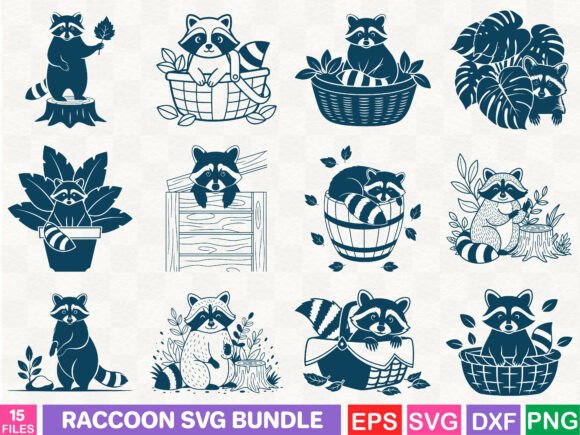
Opening the Raccoon SVG Bundle, I immediately noticed its clean silhouette and expressive simplicity — not overly cartoonish, not stiffly realistic. It lands somewhere warm and approachable: friendly enough for baby onesies, detailed enough for boutique tea towels, and balanced enough to scale across fabric types without losing charm. As an embroidery designer who’s stitched hundreds of animal motifs, I appreciate when a design avoids visual noise — no tiny floating limbs, no ambiguous outlines, no unnecessary internal lines that turn into stitch traps. This one breathes. That matters.
Real Project Test: A Custom Embroidered Tote for a Local Bakery
Last week, I used the Raccoon SVG Bundle to create a limited-run embroidered tote for a neighborhood bakery launching their “Raccoon Roll” seasonal pastry. We chose a medium-weight natural canvas tote — sturdy but with subtle texture. The raccoon sat centered on the front panel, sized to 3.8" wide. What stood out wasn’t just how it looked on screen, but how it held up under needle and thread: the ears retained shape, the eye detail stayed legible at that scale, and the curved tail flowed smoothly in satin stitch without puckering. Customers commented on how “handmade but polished” it felt — exactly the impression you want when selling small shop products.
Where It Shines (and Where It Needs Thought)
The Raccoon SVG Bundle works especially well for:
- Custom apparel — sweatshirts, crewnecks, and relaxed-fit tees where softness and character matter more than hyper-detail;
- Baby embroidery — gentle curves and minimal fine lines make it forgiving on delicate knit fabrics and safe for sensitive skin;
- Embroidered patch production — clean edges mean crisp cutouts and strong border stitches;
- Holiday embroidery and nursery decor — its neutral whimsy fits autumn harvests, woodland-themed baby showers, or quiet winter gifting;
- Etsy seller listings — it translates beautifully into printable mockups, giving digital embroidery file previews that feel authentic, not generic.
But — and this is where experience kicks in — it’s not universally plug-and-play. On thin or stretchy fabric (like lightweight jersey or ribbed baby caps), I’d recommend testing stitch density first. Dense fill areas near the face or paws can pull if stabilizer isn’t matched carefully. And while it reads well on dark fabric with high-contrast thread, avoid pairing it with ultra-fine metallics or low-coverage running stitch for the main outline — this isn’t an applique design built for heavy layering or complex underlay strategies.
Design Integrity Meets Customer Trust
When your customer sees a finished product with the Raccoon SVG Bundle stitched cleanly on a kitchen towel or pillow cover, they’re not just seeing a raccoon — they’re reading consistency, care, and intention. That’s why I pay attention to how the design handles corners, curves, and transitions between stitch types. In my test, the transition from satin-stitched ear to fill-stitched body was smooth, with no visible jump stitches or abrupt stops. That kind of polish builds trust. It tells buyers your handmade product isn’t rushed — even if it’s part of a craft business scaling up for holiday orders.
For Etsy sellers and small shop owners, that perception directly affects pricing power. A confident, cohesive motif like this supports premium positioning — especially when bundled thoughtfully (e.g., raccoon + maple leaf + acorn as a seasonal set). It also lends itself well to brand consistency: imagine using the same raccoon across packaging tags, social media banners, and embroidered staff aprons. That’s smart design asset reuse — not just decoration.
Practical Embroidery Designer Notes
Before stitching your first Raccoon SVG Bundle project, here’s what I do — every time:
- Run a test on scrap fabric matching your final substrate — especially if using textured, dark, or stretchy material;
- Check thread color contrast in both natural and artificial light; raccoon gray tones can mute on heathered fabric;
- Review stitch density in the face area — too dense, and you’ll get stiffness; too sparse, and detail vanishes;
- Confirm hoop size compatibility — while scalable, extreme resizing may require re-digitizing for optimal stitch flow;
- Inspect small details in black-and-white mockups — does the eye still read? Does the tail taper naturally?
- Compare performance on light vs. dark backgrounds — some elements (like subtle whisker lines) may need slight manual adjustment for visibility;
- Use appropriate stabilizer: tear-away for stable wovens, cut-away for knits, and lightweight fusible for lightweight linens;
- Verify licensing terms — since the listing mentions use for “prints, t-shirt designs, mug making, posters, and many other tasks,” confirm whether commercial embroidery rights are included before selling finished embroidered items or reselling the digital embroidery file;
- Remember: SVG is a vector format — for machine embroidery, you’ll need a converted embroidery file (PES, DST, JEF, etc.). Always source or digitize from a trusted provider.
Final Thought: A Quietly Versatile Workhorse
The Raccoon SVG Bundle doesn’t shout. It doesn’t need to. Its strength lies in adaptability without compromise — equally at home on a linen tea towel in a Brooklyn gift shop or stitched onto a baby blanket for a Midwest Etsy seller’s best-selling bundle. It’s not flashy illustration meant only for posters or mugs (though it works there too). It’s a considered, craft-forward Graphics choice — one that respects the limits and beauty of thread, fabric, and hand-guided intention. If you’re selecting design assets for real embroidery projects — not just screen previews — this one earns its place in your working library.