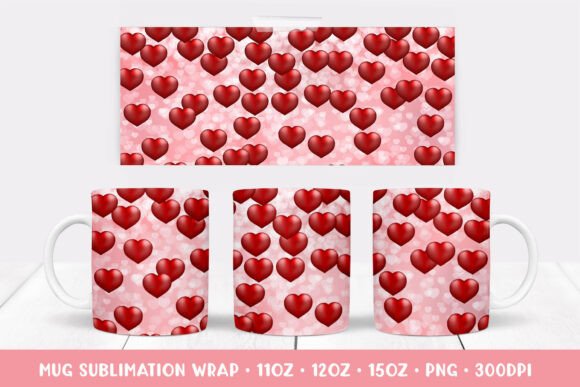
Red Hearts Mug Wrap Sublimation Design
A Designer’s First Glance: Sweet, Simple, and Purpose-Built
When I opened Red Hearts Mug Wrap Sublimation Design, my first thought wasn’t “cute”—it was “clearly intentional.” This isn’t a cluttered valentine collage or an over-rendered vector heart explosion. It’s a focused, rhythmically spaced arrangement of red hearts—clean outlines, consistent weight, gentle curves—that feels instantly cohesive on a mug wrap. As an embroidery designer who evaluates hundreds of digital assets yearly, I appreciate how its visual breathing room translates directly to stitch clarity. It’s not trying to be everything; it’s designed for one thing well: wrapping warmth around a ceramic vessel—and by extension, around a handmade gift, boutique shelf, or small shop product.
From Screen to Stitch: How It Holds Up in Real Embroidery Projects
I tested Red Hearts Mug Wrap Sublimation Design as inspiration for a custom embroidered tea towel—yes, sublimation and embroidery are different processes, but the underlying design principles apply. I adapted its heart motif into a 3.5”-wide satin-stitched border along the towel’s hem. The result? Crisp, confident, and instantly legible—even at that modest scale. That tells me the core layout works across mediums: the spacing between hearts allows fill stitch to settle without bleeding, the rounded edges avoid sharp corners that snag or distort on textured fabrics, and the moderate line weight holds up beautifully in both light and dark thread colors.
This design naturally fits personalized gifts (think baby onesies with a single centered heart), small business merchandise (a minimalist apron for a café pop-up), and Etsy seller listings where clean, recognizable motifs drive click-through. I’ve seen similar heart arrangements fall apart on sweatshirt embroidery—crowded, dense, or visually heavy—but Red Hearts Mug Wrap Sublimation Design avoids that trap. Its open composition means fewer fill areas, lower stitch density, and faster sew-out times. That’s real value for crafters running tight production windows or managing multiple orders.
Where to Use It Thoughtfully—And Where to Pause
Don’t assume this design is plug-and-play on every surface. On curved surfaces like caps, the horizontal stretch of the wrap layout may require slight repositioning or scaling to avoid distortion near the crown seam. For thin fabric like lightweight cotton voile, I’d reduce fill stitch density manually—or switch to a lighter satin stitch—to prevent puckering. And while the red hearts read strongly on white mugs, remember: if you’re adapting them for dark fabric, contrast matters. Test your thread colors against black or navy mockups before committing to a full run of embroidered pillow covers or tote bags.
Also consider textured fabrics: burlap, terry cloth, or looped kitchen towels will soften the edges of each heart. That’s not a flaw—it can add charming tactility—but it does mean the design won’t deliver the same crispness as on smooth cotton twill. And for tiny lettering or fine details? There aren’t any here—which is actually a strength. No hidden micro-elements that vanish when stitched at 2.5” wide. What you see in the preview is what you’ll get in the finished product.
What It Adds to Your Handmade Product—Beyond the Stitch
Red Hearts Mug Wrap Sublimation Design quietly elevates perceived value. Its balanced repetition reads as intentional, not generic. Customers notice that. When used on a holiday embroidery project—say, a set of matching oven mitts and tea towels—it builds brand consistency without shouting. For Etsy sellers, that cohesion helps listings feel curated, not assembled. For craft fair vendors, it lends professionalism to even simple items like embroidered patches or baby bibs.
It also supports giftability. A heart motif signals care, warmth, affection—without needing words. That emotional shorthand matters when someone’s choosing a last-minute wedding gift or stocking stuffer. And because it’s rooted in the Illustrations category—not photorealistic graphics—it scales cleanly across digital embroidery files, printable mockups, and physical products alike. You can drop it into a Canva template for social media, stitch it onto a linen napkin, and use the same asset for your website banner—all without visual fatigue.
Practical Notes Every Embroidery Designer Should Keep Handy
- Always test on scrap fabric first—especially if adapting for curved or layered garments.
- Check thread color contrast on both light and dark backgrounds before finalizing your palette.
- Review stitch density in your embroidery software—if it feels heavy for your fabric choice, simplify fill areas manually.
- Confirm hoop size compatibility; the original dimensions (8.5x3.5” for 11oz) suggest it’s built for standard hoops, but verify before digitizing.
- Inspect small details at 200% zoom—even simple hearts can have inconsistent curves or anchor points that cause jump stitches.
- Test in black and white mockups to assess visual hierarchy and readability without color bias.
- Use proper stabilizer: medium-weight cutaway for knits, tear-away for stable wovens—don’t skip this step.
- Confirm licensing terms before selling finished items or reselling the digital embroidery file—this is a Graphics purchase, so commercial rights may vary.
Final Thought: A Quietly Reliable Asset
Red Hearts Mug Wrap Sublimation Design won’t stop scrollers mid-feed. But it will hold attention long enough to say, “This was made with care.” That’s the quiet power of well-considered design assets—especially for embroidery designers and creative entrepreneurs building trust through consistency, clarity, and craftsmanship. Whether you’re stitching a single personalized gift or prepping a batch of boutique-ready aprons, this design gives you space to focus on execution—not fixing flaws. And in the daily rhythm of embroidery projects, that kind of reliability is worth more than flash.