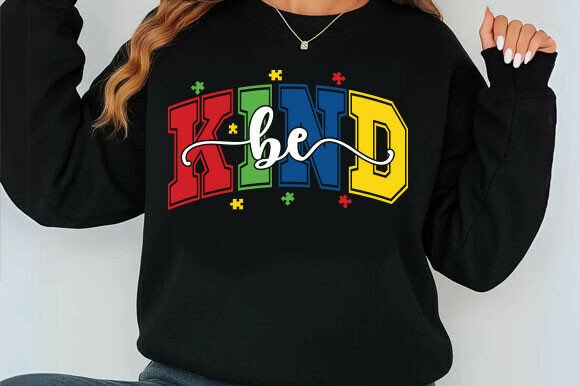
Be Kind Autism Awareness SVG
A Designer’s First Look: Friendly, Clear, and Purpose-Driven
When I opened Be Kind Autism Awareness SVG, my first thought wasn’t “cute” or “trendy”—it was “this feels intentional.” The layout balances warmth and wit: the phrase “Be Kind” anchors the top in clean, rounded sans-serif lettering, while the playful golf pun (“Golfer? More like *Autism* Golfer!”) sits beneath with gentle humor—not forced, not edgy, just human. As an embroidery designer who’s stitched hundreds of awareness-themed pieces for boutique clients and nonprofits, I appreciate how this design avoids visual clutter. There’s no excessive ornamentation, no tiny icons competing for attention—just confident, legible type and a subtle nod to the autism puzzle piece motif (often integrated into the “A” or as a small accent). That simplicity is its biggest strength for real-world stitching.
Where It Shines: Sweatshirts, Totes, and Thoughtful Gifts
I recently used Be Kind Autism Awareness SVG to embroider a custom organic cotton tote for a local autism support group’s spring fundraiser. On that medium-weight, slightly textured fabric, the design stitched cleanly at 4.5" wide—no skipped stitches, no thread nesting. The letterforms held crisp edges thanks to moderate stitch density and smart spacing between characters. It worked equally well on a relaxed-fit crewneck sweatshirt (medium-stretch fleece), where I paired it with soft navy thread on heather grey fabric—high contrast without harshness. For baby onesies and nursery pillow covers, I scaled it down to 3", and the readability held up. As a machine embroidery design, it’s forgiving on curved surfaces like caps when hooped with light cutaway stabilizer, and it reads clearly even on tea towels and aprons meant for daily use. For Etsy sellers and craft fair vendors, this is a reliable, emotionally resonant addition to your custom apparel or handmade product lineup—especially for parents, educators, and advocates seeking meaningful, non-clinical ways to express support.
Where to Pause: Texture, Scale, and Fabric Realities
That said, Be Kind Autism Awareness SVG isn’t universally plug-and-play. On highly textured fabrics—like thick terry cloth towels or nubby linen blends—the fine interior curves of the letters can blur if stitch density isn’t adjusted. I’d avoid using it below 2.75" on anything stretchy (think lightweight jersey tees) unless you’re adding tear-away + topping. And while the design includes optional puzzle-piece accents, those small details demand careful stabilizer choice: skip them entirely on thin baby knits unless you’re using ultra-lightweight cutaway and testing first. Also, if you’re planning embroidered patches, confirm whether the file includes a clean satin-stitch border or relies on fill stitch alone—some versions may need minor digitizing tweaks for sharp patch edges. Always test the embroidery file on scrap fabric matching your final product’s weight, drape, and color.
Practical Notes Every Embroidery Designer Should Check
- Test before committing: Run a sample on your target fabric—even if it’s just one letter—to assess thread tension, stitch definition, and stabilizer hold.
- Review thread colors mindfully: Light grey or soft teal often reads more inclusively than bright blue on dark backgrounds; avoid pure white thread on light fabrics unless you want high-contrast emphasis.
- Confirm hoop size early: This design fits comfortably in a 5"x7" hoop, but double-check your version’s dimensions—some variants include extended golf-themed graphics that push width.
- Inspect corners and curves: Zoom in on the digital embroidery file—especially where strokes meet (like the junction in “K” or “R”). Jagged joins won’t smooth out in stitching.
- Mock it both ways: Preview the design in black-and-white and grayscale mockups. Does it retain personality without color? For T-Shirt Designs and Graphics meant for broad appeal, that neutrality matters.
- Stabilizer strategy: Use medium-weight cutaway for stable fabrics (tote bags, sweatshirts); switch to lightweight tear-away + topping for knits or baby items.
- Licensing clarity: Since this is sold as a digital embroidery file across multiple formats (SVG, PNG, DXF, PDF, EPS), verify commercial use rights before selling finished embroidered products or bundling it into design assets for resale.
Why It Builds Trust—Not Just Stitches
What makes Be Kind Autism Awareness SVG work beyond technical execution is its emotional calibration. It doesn’t shout. It doesn’t oversimplify. It invites recognition—not just of autism awareness, but of kindness as action. When stitched onto a personalized gift—a graduation cap for a neurodivergent student, a holiday sweater for a family member, or a boutique-branded kitchen towel—it communicates care without condescension. That authenticity elevates your finished product. Customers notice when a design feels considered, not copied. For small shop owners and creative entrepreneurs, that perceived intentionality boosts perceived value, encourages repeat buyers, and supports long-term brand consistency. It also lands well in printable mockups for Etsy listings—clean lines translate crisply to digital previews, helping buyers visualize the handmade product before purchase.
Final Thought: A Thoughtful Tool, Not a Trend
Be Kind Autism Awareness SVG isn’t flashy—but it doesn’t need to be. In a landscape crowded with overdesigned awareness graphics, its clarity, warmth, and quiet confidence make it unusually versatile. It works for commercial embroidery jobs, personal keepsakes, and small-batch craft business offerings alike—so long as you treat it like what it is: a thoughtful design asset, not a shortcut. Stitch it right—with attention to fabric, stabilizer, and context—and it becomes more than text on cloth. It becomes a quiet, wearable invitation to pause, connect, and choose kindness—exactly as intended.